
Why GladiosWAF Is Not Just Another WAF
Traditional WAFs are useful, but many still depend heavily on rules, signatures, and constant tuning. GladiosWAF takes a different approach by focusing on AI-based request intent classification — understanding what a request is trying to do, not just what pattern it matches.
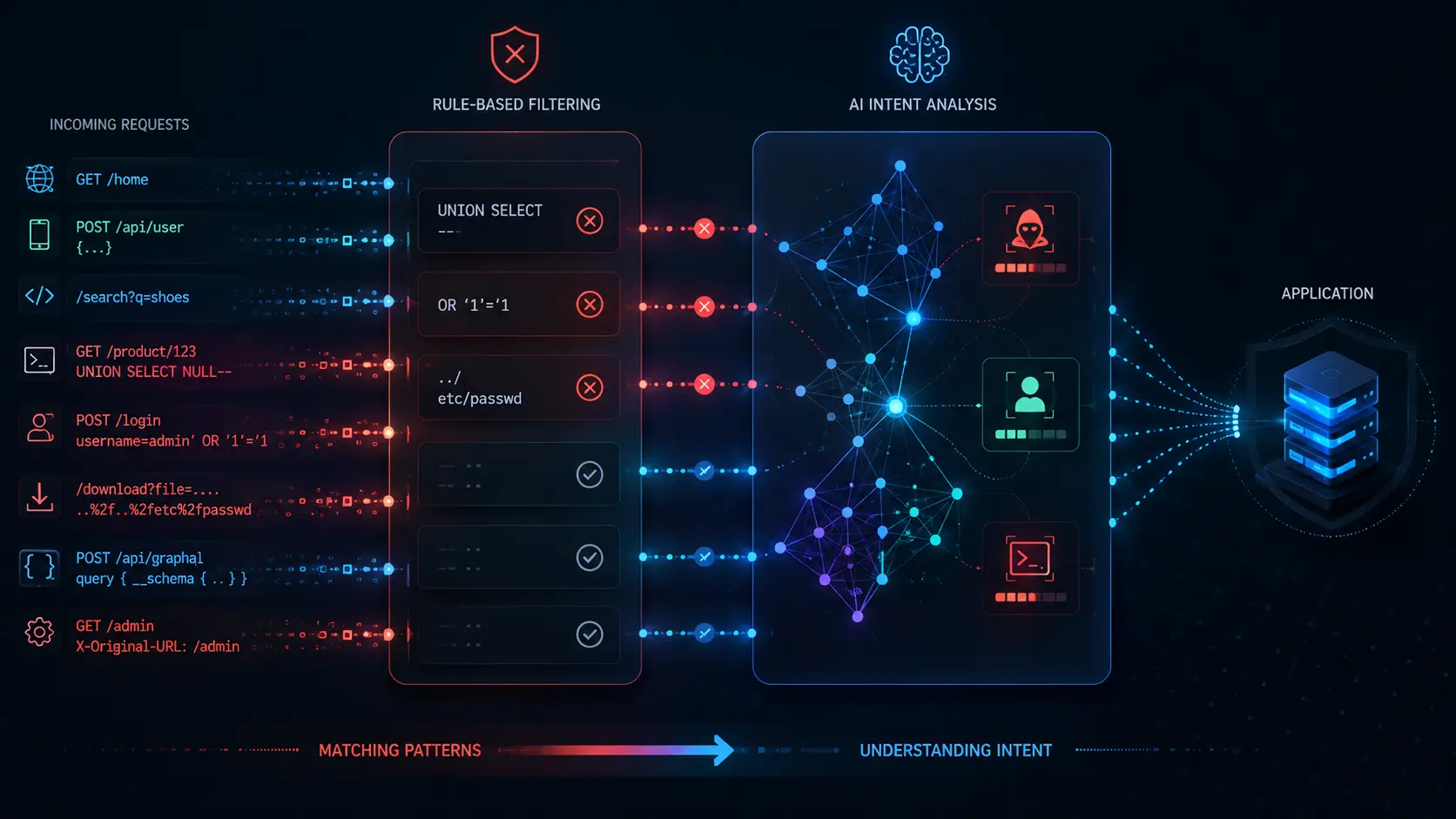 AI-based WAF diagram comparing traditional rule-based filtering with request intent analysis before traffic reaches an application.
Most people already know what a WAF does.
You put something in front of your application. It inspects incoming requests. If something looks suspicious, it blocks it before your application ever sees it.
That model has worked for years. I'm not going to pretend otherwise. Cloudflare WAF, AWS WAF, FortiWeb, Imperva, F5 — these products exist because real applications get hit with real attacks, and a lot of the time, these tools catch them. They handle common attack patterns, managed rules, rate limiting, bot mitigation, API protection.
So the question isn't whether traditional WAFs are useful.
They are.
The question is: if all of this already exists, why build GladiosWAF?
The First Question Everyone Asks
When people hear about GladiosWAF, the first version of this question comes pretty quickly:
"How is this different from FortiWeb, Cloudflare WAF, or AWS WAF?"
It's a fair question. These are established products. They already protect websites and APIs. They already inspect traffic before it reaches your application.
So if I just say "GladiosWAF protects applications before malicious requests reach your app logic" — that's not enough. Because many WAFs already do that.
The real difference isn't where the protection sits.
It's the detection philosophy.
The Payload That Makes the Point
Take this:
<s vg /o nl oa d= ev al (/ *% 0A */ St ri ng [/ *% 0D */ %2 7f ro mC ha rC od e% 27 /* %E F% BB %B F.........
This is an XSS payload. Specifically, it's trying to execute eval() through an SVG onload handler. If you reassemble it, the intent is obvious.
But it's been deliberately fragmented. Whitespace inserted between characters. URL encoding mixed in. The string broken apart so it doesn't look like anything a signature would recognize.
A WAF looking for <svg/onload=eval( as a contiguous string won't find it here. The pattern is gone. The intent is still very much there.
And this isn't unique to XSS. The same principle applies across every common attack type.
A simple SQL injection attempt may first appear as an obvious pattern like:
' OR '1'='1
But the same idea can be mutated by changing spacing, inserting comments, encoding characters, or splitting keywords. The payload may look different, but the intent remains the same: manipulate the database query.
A script tag can become a different HTML event-based payload. A direct ../ path can become an encoded path. The surface form changes, but the underlying goal remains malicious.
That is the problem with relying too heavily on exact pattern matching.
The attack does not need to look the same.
It only needs to mean the same thing.
The Rule-Writing Trap
The natural response is: fine, write a rule that normalizes whitespace first, then checks for the pattern.
That works — until the attacker removes the spaces and splits it differently. Or switches to unicode encoding. Or uses HTML entities. Or mixes all three.
So you write another rule. And another. And another.
Each rule is a response to something you've already seen. The attacker just has to find one angle you haven't written for yet. With AI tools today, generating new payload variations takes seconds. The defender is always one step behind because you can only write rules for attacks you already know about.
This is an industry-wide WAF challenge — not a Cloudflare problem, not a FortiWeb problem, not an AWS WAF problem. Many of them already have strong managed rules, updated signatures, schema validation, bot controls, and machine learning features. But no WAF is completely immune to payload mutation when the attack surface keeps shifting.
The rule-writing approach is fundamentally reactive. And for teams without a dedicated security person tuning rules every week, it's just not a realistic long-term answer.
What Actually Needs to Change
Rules ask: does this request match a known bad pattern?
But that fragmented payload doesn't match any clean pattern. Strip away the obfuscation, reassemble it — and the intent is obvious. The form changed. The goal didn't.
What needs to happen is the WAF stops asking "does this match something I've seen before" and starts asking "after I reconstruct this input, what is it actually trying to do?"
That's a different problem. And it's difficult for rules alone to solve well, because every new variation creates another pattern to account for.
What GladiosWAF Does Differently
GladiosWAF is designed around that second question.
Instead of maintaining a library of patterns and hoping attackers stay predictable, it focuses on classifying request intent. The exact characters in the payload can change. The encoding can change. The fragmentation can change. But if the underlying behavior is trying to inject, execute, traverse, or manipulate — that's what gets flagged.
That doesn't mean rules have no place. Some known attacks are well-defined enough that a signature catches them cleanly. But for anything dynamic, mutated, or AI-generated — intent classification is a more honest defense.
Who This Is For
GladiosWAF isn't trying to replace every enterprise WAF feature.
Large organizations that need DDoS protection, compliance controls, global edge networks, and SIEM integration have the right tools for that already. GladiosWAF works alongside them, not instead of them.
The teams GladiosWAF is designed for are the ones who don't have a dedicated person tuning WAF rules every week. SaaS companies. API-first products. Developer-led teams where security is everyone's side job and nobody has time for an endless rule maintenance loop.
For those teams, the value is simple:
Send the request for classification. Determine whether the intent looks malicious. Allow or block based on the result.
No rule library to maintain. No constant tuning. No chasing the next payload mutation.
What GladiosWAF Does Not Do
A WAF is not a substitute for building software carefully.
GladiosWAF will not save an application with broken authentication, no access control, or unparameterized queries. Developers still need to care about what happens inside the application. GladiosWAF sits in front of it — what happens inside is still yours to own.
The Real Question
Most teams shouldn't be asking "do I need a WAF."
The better question is: do I want my protection model to depend entirely on rules and signatures — where every new payload mutation becomes another maintenance problem — or do I want something that reasons about what a request is actually trying to do?
That fragmented payload near the top of this article is a good example of why that question matters.
The pattern was gone. The intent was still there.
GladiosWAF is built to catch the intent.