
Why Machine Learning Belongs in the Future of Web Application Security
Most WAF failures are not missed detections. They are requests the WAF never fully read, or parsed differently from your application — and neither one shows up on the dashboard
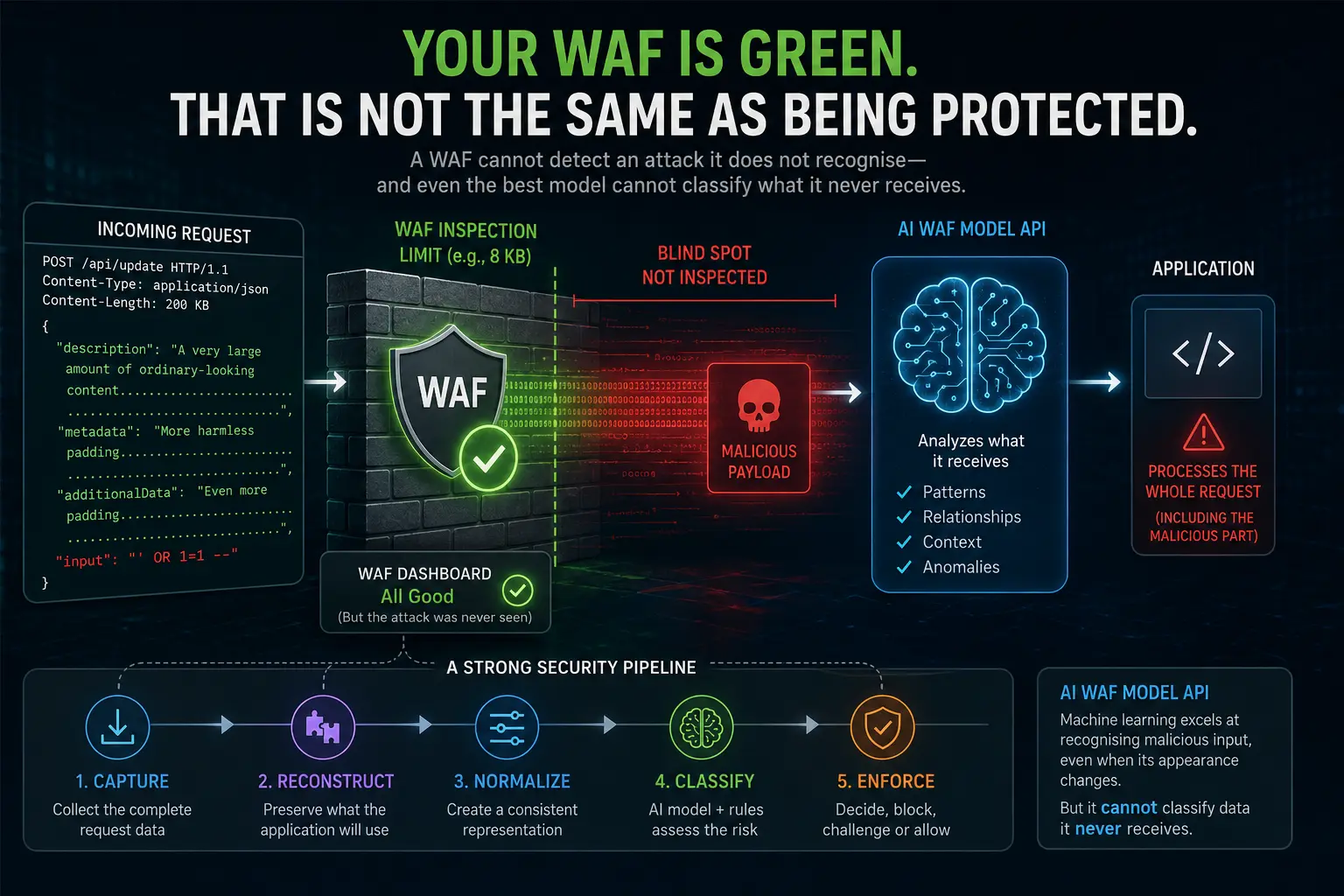 Infographic showing a WAF inspecting only part of a large web request while a hidden malicious payload passes through to the application, with an AI WAF model API and a five-stage security pipeline: capture, reconstruct, normalize, classify, and enforce.
Your WAF Is Green. That Is Not the Same as Being Protected.
You place a Web Application Firewall in front of your application.
The dashboard shows traffic flowing through it. A few suspicious requests have been blocked. There are no obvious incidents. Everything is green.
It looks as though the problem has been handled.
For many attacks, it has. A WAF blocks a great deal of automated scanning, commodity exploitation, and malicious traffic. Running an internet-facing application without one is generally worse than running with one.
But there is an important difference between:
The WAF is running.
and:
The WAF inspected the part of the request that could harm the application.
Most dashboards do not make that difference visible.
A request that was inspected and incorrectly allowed may appear as a missed detection.
A request whose dangerous content was never inspected may simply appear as normal traffic.
This article is about that gap: what sits inside it, why it is often structural rather than merely a configuration mistake, and where machine learning genuinely improves web application security versus where it changes nothing at all.
The Mental Model Most People Start With
The common mental model of a WAF is straightforward.
A request arrives.
The WAF reads it, compares it against known attack patterns, and blocks anything that matches.
That description is broadly correct. It is also why the first concern is usually coverage:
Does the WAF cover the attacks I know to look for?
It is worth pausing on that question, because most teams answer it before deployment rather than after.
When you place a WAF in front of your application, do you already know which rules your application will need?
Very few teams do. They enable a managed rule set, watch for breakage, and adjust. That is a reasonable way to start.
But coverage is only half of the problem.
For a detection rule to work, two conditions must be true. The malicious content must still resemble the pattern the rule describes. And the rule must actually be applied to the part of the request containing that content.
The first condition fails when attackers transform or obfuscate payloads.
The second fails when the security layer truncates, discards, misparses, or never receives the dangerous part of the request.
The second failure is harder to recognise, because it happens quietly.
The Same Attack in Different Clothes
Start with the first condition: representation.
A classic SQL injection attempt may contain:
UNION SELECT
A literal signature can detect that sequence.
But the same underlying instruction may be represented differently:
UN/**/ION SEL/**/ECT
SeLeCt * FrOm users
/*!50000 SELECT*/
Depending on the database engine, SQL dialect, and execution context, these variations may still be interpreted as meaningful SQL.
A simplistic string match may not treat them as equivalent.
The same issue appears in cross-site scripting.
A rule searching for:
<script>
may not recognise:
\u003cscript\u003e
after the content has been transformed into Unicode escapes.
HackVitraSec Solutions discusses these techniques in Advanced WAF Bypass Techniques Used by Attackers https://hackvitrasec.medium.com/advanced-waf-bypass-techniques-used-by-attackers-895758c71668, alongside URL encoding, layered encoding, Base64, HTTP parameter pollution, nested JSON, and header manipulation.
These are not entirely new attacks.
In many cases, the attacker is changing the appearance of an existing attack while preserving its intended effect.
Normalisation Helps, but It Becomes a Treadmill
WAF vendors respond by normalising requests before inspection — converting text to a consistent case, decoding URL-encoded values, interpreting Unicode escapes, collapsing whitespace, removing comments.
This is necessary and useful.
But it can become a treadmill.
Each new transformation introduces another normalisation rule. Each rule has exceptions. Each exception creates additional complexity.
Eventually, organisations may no longer be confident about exactly what the WAF transforms, what it leaves untouched, and whether the application interprets the same value in the same way.
Aggressive normalisation can also create another problem: false positives.
Many legitimate applications intentionally carry content that resembles an attack.
A developer platform may accept JavaScript source code.
A support ticket may include the payload that caused a page to fail.
A cybersecurity course may display:
' OR 1=1 --
as a teaching example.
A security testing platform may intentionally receive malicious samples for authorised analysis.
A rule that blocks suspicious-looking text everywhere may protect one application while breaking another.
This is why false positives are not a minor inconvenience.
They are one of the main reasons WAF configurations degrade over time.
Rules are disabled.
Exceptions grow.
Entire routes are excluded.
Teams gradually loosen protection because the security layer interferes with legitimate use.
The Part of the Request Nobody Inspected
Representation is only one source of failure.
The more surprising problem is visibility.
Many WAF deployments inspect request bodies only up to a configured limit. That limit exists for understandable reasons: inspecting every byte of every request consumes CPU, memory, latency, and buffering capacity, and it exposes the security layer itself to denial-of-service pressure from very large requests.
The danger is that the application may process more data than the WAF inspected.
An attacker who knows or estimates the inspection limit may not need to disguise the malicious content at all.
They may place enough benign-looking material before it:
{
  "description": "A very large amount of ordinary-looking content...",
  "metadata": "More harmless-looking padding...",
  "additionalData": "Even more padding...",
  "input": "malicious content placed deep in the request"
}
The malicious portion may be completely unobfuscated.
Any appropriate rule or model could recognise it.
But the WAF inspects only the beginning of the body, finds nothing suspicious, and allows the request.
The application then parses the complete body, including the part the WAF never examined.
The rule did not fail.
The classifier did not fail.
Neither was given the relevant data.
Payload Padding Exploits the Inspection Boundary
Prophaze examined this problem in The 2026 WAF Blind Spot: Why Payload Padding Lets Attack Slip Through https://www.prophaze.com/payload-padding-waf-bypass-blind-spot.
The article describes attackers placing large amounts of benign-looking filler—such as JSON arrays, Base64 blobs, or random strings—before the malicious portion of a request.
If a WAF has a fixed inspection boundary, that boundary can become predictable.
The attacker does not necessarily need to bypass a signature.
They only need to position the attack beyond the bytes to which the signature will be applied.
This produces a particularly dangerous kind of false confidence.
The WAF dashboard remains green because the inspected portion of the request was benign.
The application remains exposed because it processed more than the WAF examined.
That distinction matters for any application accepting large JSON documents, Base64-encoded content, file uploads, GraphQL variables, multipart forms, or bulk API operations.
The first question should not be:
Did the WAF recognise the payload?
It should be:
Did the WAF inspect the complete security-relevant portion of the request?
A Perfect Classifier Still Cannot See Missing Data
This is where claims about AI security need to become precise.
A machine-learning model may be better than literal signatures at recognising transformed or unfamiliar payloads.
But it cannot classify bytes it never receives.
Suppose a 200 KB request contains malicious content near the end, but the middleware sends only the first 8 KB to the model.
The model may classify that 8 KB as benign.
That is not necessarily a model error.
It correctly evaluated the input it received.
The security failure happened earlier in the pipeline.
This is the single most important principle when evaluating an AI WAF Model API:
The model cannot classify data it never receives.
It applies not only to truncated bodies, but also to discarded fields, omitted headers, flattened objects, lost duplicate parameters, and incorrectly reconstructed multipart content.
When the WAF and Application Read Different Requests
There is another class of failure that has little to do with detection quality.
Consider a URL containing the same parameter twice:
?id=1&id=1 OR 1=1
Duplicate parameters are not interpreted consistently across every proxy, framework, and programming language.
One component may use the first value.
Another may use the last.
A third may combine them into an array.
The WAF might interpret the request as:
id=1
while the application interprets it as:
id=1 OR 1=1
Both components processed the request according to their own parser behaviour.
The vulnerability lies in the disagreement.
A better signature does not solve that problem.
A more accurate model does not solve it either.
If the dangerous second value was discarded before classification, the classifier never had an opportunity to assess it.
The fix is alignment.
The security layer and the application should operate on a consistent interpretation of the request.
Duplicate values should not disappear silently before inspection.
Content-Type Confusion Creates the Same Problem
Content type can produce a similar mismatch.
A request may declare:
Content-Type: text/plain
while the backend parses the body as JSON anyway.
An endpoint intended to accept JSON may also quietly accept:
application/x-www-form-urlencoded
through a separate code path with weaker validation.
The WAF makes a decision based on the declared format.
The application makes a decision based on what its framework is willing to parse.
The two layers are no longer evaluating the same request.
HackVitraSec includes content-type confusion and HTTP parameter pollution alongside encoding and obfuscation techniques, but they are fundamentally different kinds of failure.
Encoding challenges recognition.
Parser inconsistency challenges interpretation.
The latter is largely immune to better detection.
Even an ideal classifier cannot protect an application if the classifier and application are given different representations of the request.
The application should reject content types, structures, and methods it was never designed to accept.
Deterministic enforcement is better than probabilistic classification whenever the requirement is unambiguous.
Modern APIs Make Visibility Harder
Traditional WAF discussions often focus on query strings and HTML forms. Modern applications communicate through REST APIs, deeply nested JSON, multipart bodies, webhooks, mobile backends, GraphQL, and custom headers — and the security-relevant value is rarely sitting at the top level where it is easy to find.
A JSON-based injection attempt might resemble:
{
  "username": {
    "$ne": null
  },
  "password": {
    "$ne": null
  }
}
A suspicious value may also be buried inside multiple levels of nesting:
{
  "data": {
    "customer": {
      "preferences": {
        "metadata": {
          "command": "suspicious value"
        }
      }
    }
  }
}
A security layer that inspects only top-level values may miss it.
A middleware that flattens the request into a simplified object may remove the context needed for meaningful classification.
A client library that truncates long fields may create an inspection gap without making that behaviour visible.
GraphQL concentrates the problem. The security meaning may sit in the operation name, the arguments, the variables, or several levels of nested selection — while a path-based view sees only repeated traffic to /graphql and learns nothing about what any of it is attempting.
The model needs a meaningful representation of the request, not an arbitrary substring or a convenient selection of fields.
A Security Pipeline Has Five Stages
It is helpful to stop thinking of a WAF as one indivisible product.
A more accurate model is a five-stage pipeline:
Capture. Reconstruct. Normalize. Classify. Enforce.
Capture collects the request information relevant to the security decision — body, parameters, duplicate values, selected headers, method, path, content type, GraphQL operation and variables.
Reconstruct reassembles the values the application will actually consume: multipart fields, fragmented values, duplicate parameters, nested objects, encoded or compressed content.
Normalize creates a consistent representation without changing the meaning the application will interpret. It should reduce superficial variation while avoiding transformations that cause the two layers to disagree.
Classify determines whether the request resembles malicious or legitimate traffic, using rules, signatures, a model, behavioural signals, or a combination.
Enforce decides what happens next — allow, block, log, challenge, throttle, or escalate for review.
Machine learning occupies the classification stage.
It depends heavily on the quality of the four stages around it.
Where Machine Learning Actually Helps
Rules typically answer:
Does this request contain a pattern someone has already described?
A trained model answers a different question:
Does the overall composition of this request resemble malicious input?
A model can evaluate multiple properties together rather than relying on one literal string.
This means superficial changes to an attack — mixed casing, inserted comments, alternate spacing, encoding, unusual token combinations — do not necessarily require a new standalone rule for every mutation.
Machine learning can also help with false positives.
A well-designed model should not be trained only on obvious attacks and simplistic benign phrases. Real benign traffic contains source code, HTML, Markdown, SQL terminology, Base64, URLs, error logs, and long technical text — and a model that has never seen any of it will treat all of it as hostile.
By learning from both malicious examples and realistic difficult benign examples, a model may become better at distinguishing an actual attack from legitimate content that merely looks suspicious.
This is a real improvement.
But it addresses only the representation problem.
It does not solve missing visibility.
It does not solve parser disagreement.
It does not solve broken authentication or authorisation.
It does not solve application code that executes unsafe input.
Why Adding More Signatures Is Not the Same as Machine Learning
Both signatures and models detect patterns.
The difference lies in how those patterns are developed and maintained.
A signature-based system relies on humans describing explicit conditions: detect this keyword, block this sequence, decode this format, add an exception for this route.
A supervised machine-learning system learns from labelled examples instead.
That does not remove the engineering work.
The work moves into dataset construction, labelling, realistic benign coverage, attack variation, adversarial testing, false-positive analysis, model evaluation, deployment monitoring, versioning, and drift detection.
The proprietary value of a commercial model may lie in its training data, feature engineering, preprocessing, and decision logic.
Those implementation details do not need to be published for the security principle to remain clear.
Where an AI WAF Model API Fits
An AI WAF Model API gives developers access to request classification without requiring them to build and operate their own machine-learning system.
The application captures and prepares the request, submits it, and receives a classification.
The model provides a security verdict.
The application decides how to act on it.
This is the architectural direction behind GladiosWAF: an AI WAF Model API for developers securing web applications, REST APIs, and GraphQL endpoints.
But the API can assess only the representation submitted to it.
The integration remains responsible for ensuring that relevant content is captured, that bodies are not silently truncated, that nested structures and duplicate parameters survive, that security-relevant headers are deliberately included, and that the submitted representation matches what the application will actually process.
A model API is not the whole WAF pipeline.
It is the classification layer within that pipeline.
What Machine Learning Cannot Fix
Some problems should not be delegated to a classifier at all.
An endpoint accepting a username and password should reject a 20 MB body outright.
It should not accept the request merely because a model classified the content as benign.
Request size, schema, content type, allowed methods, and required fields are deterministic application decisions.
Deterministic controls should be used whenever the requirement is clear.
Machine learning is better suited to the ambiguous remainder: requests that are transformed, unusually structured, or difficult to describe through an exact pattern.
It also cannot replace parameterised queries, output encoding, authentication, authorisation, server-side validation, schema enforcement, rate limiting, secure proxy configuration, or complete request capture.
And a model evaluating one request in isolation cannot see distributed attacks, low-and-slow abuse, rate-limit evasion, behavioural patterns across sessions, or broken access control inside the application.
Those require other layers.
The Future Is Not Rules Versus Machine Learning
The useful question is not whether rule-based WAFs are obsolete.
They are not.
Rules remain effective for known attack patterns and deterministic policies. Schemas reject invalid structures. Size limits keep inappropriate payloads out. Application code enforces business rules. Authentication and authorisation remain application responsibilities.
Machine learning adds value where the request is ambiguous and the attack does not present itself in one predictable form.
Underneath all of it sit two separate requirements.
A security layer must recognise malicious input even when its appearance changes.
And it must actually receive that input, in the form the application will process it, before recognition is possible.
Machine learning strengthens the first.
Complete capture, consistent parsing, reconstruction, and sensible limits are what satisfy the second.
Neither is sufficient alone.
So the most important question is not whether your WAF is rule-based or machine-learning-based.
It is whether the security layer sees the same request your application will process—and whether each layer is enforcing the controls it is best suited to enforce.
That is where the real protection gap usually sits.
And it is worth checking before the green dashboard convinces you that nothing is wrong.
Sources and Acknowledgement
This article draws on concepts and illustrative bypass techniques discussed in:
Advanced WAF Bypass Techniques Used by Attackers, published by HackVitraSec Solutions on Medium, covering payload encoding, SQL keyword obfuscation, HTTP parameter pollution, fragmented payloads, nested JSON, content-type confusion, header manipulation, SSRF, and behavioural evasion.
The 2026 WAF Blind Spot: Why Payload Padding Lets Attack Slip Through, written by Prasad G and published by Prophaze in April 2026, examining payload padding, partial request inspection, fixed inspection limits, deeply positioned malicious content, streaming inspection, and protocol-aware parsing.
The discussion of machine-learning classification, AI WAF Model APIs, and GladiosWAF represents the author's own analysis of how model-based request classification fits within a broader defence-in-depth architecture.